
You’ve found a mattress you love, chosen the right firmness and settled on the size. Then comes a question you might not have expected.
“Will you need a box spring with that?”
For some shoppers, the answer seems obvious. They’ve always had a box spring underneath their mattress, so naturally they’ll need another one.
Others assume that modern mattresses don’t require box springs at all.
The reality falls somewhere in between.
Today’s mattresses can be supported by several different types of foundations, and the right choice depends on the mattress construction, the bed frame and the manufacturer’s recommendations.
Before you spend money replacing a perfectly good foundation, or decide to keep one that isn’t suitable, it’s worth understanding what’s actually holding your mattress up.
First, what does a box spring actually do?
Traditionally, a box spring was exactly what its name suggests: a wooden or metal frame containing springs.
It was designed to sit beneath a mattress, providing an elevated support surface with some flexibility.
Older innerspring mattresses were often designed to work with these spring-based foundations as a complete system.
However, mattress construction has changed significantly.
Many modern mattresses use individually wrapped coils, specialized foams, latex or combinations of several materials. These designs may require a firmer, more stable support surface than an older spring-based box spring provides.
That’s why the term “box spring” can be confusing today.
Some products sold or casually described as box springs don’t actually contain springs. They’re rigid foundations designed to support the mattress without noticeable flexing.
They may look similar from the outside, but they don’t necessarily function the same way.
So, does a modern mattress need a box spring?
Not always.
Many modern mattresses can be used with a compatible platform bed, solid foundation or adjustable base instead of a traditional box spring.
Some mattresses may still be designed for use with specific box springs or matching foundation systems.
The important distinction is that every mattress needs appropriate support, but that support doesn’t necessarily have to come from a box spring.
For example, a modern memory foam mattress may require a stable, non-flexing surface. Placing it on an old, springy box spring could allow movement or uneven support that the manufacturer never intended.
A different mattress might be compatible with several foundation types, provided they meet the required structural specifications.
The best approach is to check the manufacturer’s instructions for your particular model rather than assume that one foundation works with everything.
Understanding the different types of mattress foundations

There are several common support options, each with its own characteristics.
Traditional box springs
A traditional box spring contains an internal spring system that gives slightly under pressure.
These were commonly paired with older innerspring mattresses.
Depending on its construction, a traditional box spring may still be appropriate for certain mattresses, but it isn’t automatically compatible with modern foam or hybrid models.
If you’ve owned your current box spring for many years, don’t assume it will work with your next mattress simply because the dimensions match.
Rigid mattress foundations
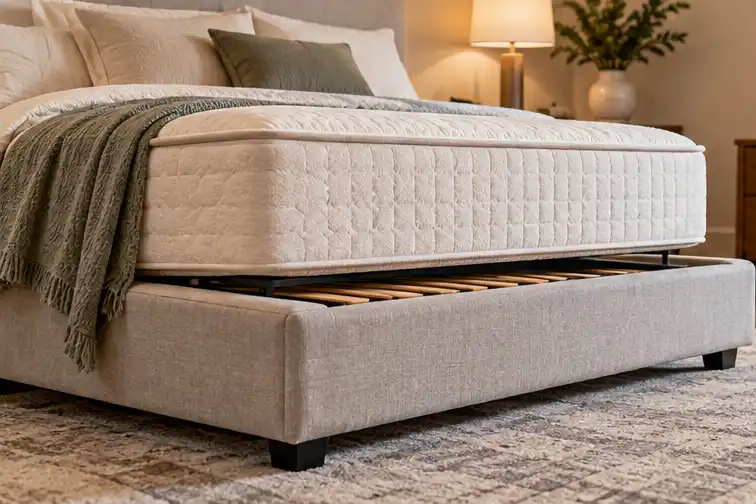
A rigid foundation typically contains a structural frame or reinforced support surface without the spring action of a traditional box spring.
Many are upholstered, giving them a similar appearance to a conventional box spring.
Their purpose is to create a stable surface beneath the mattress and raise the overall height of the bed.
Some manufacturers offer matching foundations designed specifically for their mattresses.
These can be a straightforward choice because compatibility has already been considered as part of the product system.
Platform beds
Platform beds are popular because they often eliminate the need for a separate box spring or foundation.
The bed frame itself provides the mattress support, usually through a solid platform or a series of wooden or metal slats.
However, not all platform beds offer the same level of support.
The spacing between the slats, their strength and the presence of center support can determine whether a particular mattress is compatible.
Wide gaps or insufficient support may allow a mattress to sag between the slats.
A platform bed can be an excellent option, but it’s important to check the mattress manufacturer’s specific requirements before using one.
Adjustable bases
Adjustable bases allow you to elevate the head, feet or both, creating different positions for sleeping, reading or relaxing.
They also provide the structural support beneath a compatible mattress.
Many modern foam and hybrid mattresses are designed to work with adjustable bases, although compatibility varies by model.
If you’re considering an adjustable base, confirm that both the mattress and the base are designed to be used together.
You can also explore The Sleep Center’s Mattress Products page for an introduction to the available mattress brands and adjustable sleep systems.
Can you use your old box spring with a new mattress?
Possibly, but it’s worth checking before making that decision.
A foundation that’s worked well for the past decade may not be suitable for a new mattress with a completely different construction.
Start by checking its condition.
Does it have noticeable sagging, damaged supports, broken components or unusual movement? Does it creak excessively or feel unstable?
Even if the foundation looks fine from the outside, its internal structure may have deteriorated over time.
Next, check whether it’s compatible with the new mattress.
The manufacturer’s requirements are more important than the age or appearance of the foundation.
Keeping an existing foundation can save money when it’s in good condition and meets the specifications for your new mattress.
Keeping an incompatible foundation, however, may undermine the comfort and support you were hoping to gain.
Why the right foundation matters more than you might think
When people notice their mattress sagging or feeling uncomfortable, they often assume the mattress itself is responsible.
Sometimes that’s true.
But an unsuitable or deteriorating foundation can also contribute to the problem.
Imagine placing a perfectly supportive mattress on a bed frame with a weak center rail.
Even if the mattress was designed to distribute body weight evenly, the structure underneath it may allow the middle of the bed to dip.
Similarly, slats that are too widely spaced can leave portions of the mattress insufficiently supported.
A suitable foundation helps the mattress function as intended.
It also contributes to overall bed stability, supports the combined weight of the mattress and sleepers, and may help maintain the mattress’s shape over time.
Think of it like the foundation of a house. You can invest in excellent materials above it, but they still need a sound structure underneath.
Can the wrong foundation affect your mattress warranty?
Yes, and this is something every mattress shopper should understand.
Manufacturers frequently specify which foundations, support surfaces and bed frames are acceptable for their products.
Using an unsupported or unsuitable foundation may affect warranty coverage, particularly if it contributes to damage or sagging.
Requirements are not universal.
One manufacturer may allow a slatted platform with a particular maximum gap between slats, while another requires narrower spacing or additional structural support.
For example, published guidance from Tempur-Pedic and Serta specifies different slat-spacing requirements for certain mattresses. Tempur-Pedic+1
That doesn’t mean one brand is right and another is wrong. Their mattresses have different constructions and support specifications.
Before purchasing a new mattress, ask which foundations are approved and whether your existing bed setup meets the requirements.
It’s a simple question that can prevent an expensive misunderstanding later.
Do you need a foundation if you have a platform bed?
If your platform bed already provides the support required by your mattress manufacturer, you may not need an additional foundation.
A solid, structurally sound platform can support many mattress designs directly.
A slatted platform may also be suitable if the slats meet the manufacturer’s spacing, width and support requirements.
However, simply owning a platform bed doesn’t guarantee compatibility.
Some decorative bed frames have widely spaced slats or support systems that weren’t designed for heavier modern mattresses.
The safest choice is to confirm the specifications rather than relying on the bed’s appearance.
And remember that placing an additional foundation on top of a platform bed can substantially increase the overall bed height.
What about putting a mattress directly on the floor?
It might seem like the simplest solution. After all, the floor is flat and certainly isn’t going to collapse.
But placing a mattress directly on the floor isn’t generally the best long-term arrangement.
Depending on the flooring, room conditions and mattress construction, moisture may become trapped underneath, particularly where airflow is limited.
There’s also the practical issue of getting into and out of a bed that’s only a few inches above the floor.
Some mattress manufacturers specifically advise against floor placement or exclude it from approved support arrangements.
If you’re considering this approach, check the manufacturer’s guidelines first.
A compatible platform or foundation is usually a more practical way to provide proper support and elevation.
Don’t overlook the height of your bed
Foundation selection isn’t just about what happens underneath the mattress.
It also affects the finished height of your bed.
Modern mattresses can be quite thick, and combining a tall mattress with a high-profile foundation may create a sleeping surface that’s higher than you’re comfortable with.
Alternatively, a low-profile platform bed may feel too low for someone who prefers getting in and out of bed from a seated position.
Before choosing a foundation, consider the combined height of your mattress, support system and bed frame.
Ideally, you should be able to sit on the edge of the bed and get in and out comfortably.
If bed height is important to you, ask about low-profile foundations or other compatible options.
Five questions to ask before buying a mattress foundation
You don’t need to understand every engineering detail of a mattress support system, but a few practical questions can help you avoid mistakes.
- Does my new mattress require a particular type of foundation? Find out which support options the manufacturer approves.
- Can I reuse my existing bed frame or box spring? Check compatibility as well as the condition of your current setup.
- Does my platform bed provide enough support? Ask about slat spacing, structural strength and center support.
- Would an adjustable base be compatible? If adjustable positioning appeals to you, confirm that the mattress is suitable.
- How high will the finished bed be? Consider how the mattress and foundation heights work together.
Getting these answers before delivery is much easier than discovering afterward that your existing bed frame isn’t suitable.
Frequently Asked Questions
Do memory foam mattresses need a box spring?
Many memory foam mattresses do not need a traditional box spring. They often require a stable, firm support surface, such as a compatible rigid foundation, platform bed or adjustable base. Always check the specific manufacturer’s requirements.
Can a hybrid mattress go on a box spring?
Some hybrid mattresses can be used with certain box springs or foundations, while others require a rigid support system. Compatibility depends on the mattress model and the foundation’s construction.
Is a platform bed better than a box spring?
Neither is automatically better. A properly designed platform bed can provide excellent support, while a manufacturer-approved foundation can be equally suitable. The correct choice depends on the mattress and your preferred bed setup.
Can an old box spring damage a new mattress?
An old or incompatible box spring may contribute to uneven support, excessive movement or premature wear. Its condition and compatibility should be checked before pairing it with a new mattress.
Do adjustable beds need box springs?
Generally, no. An adjustable base provides the support surface for a compatible mattress and does not normally require a separate box spring.
Build the right sleep system from the ground up
Choosing a new mattress is an investment in your comfort, but the mattress is only one part of the equation.
The foundation beneath it plays an important role in how the mattress performs, how stable your bed feels and whether you’re following the manufacturer’s support requirements.
You don’t necessarily need to buy a new box spring every time you replace a mattress.
You do, however, need to make sure the foundation you’re using is right for the mattress you choose.
At The Sleep Center, our mattress experts can help you compare mattresses, foundations and adjustable bases so that every part of your sleep setup works together.
With six Florida showroom locations, you can get answers to your questions, see available options in person and make a more confident decision.
Find your nearest Sleep Center location and discover why we’re The Mattress Store Where You Get More!
Explore Mattress Education
Related Articles

How to Test a Mattress in a Store Before You Buy
There’s a familiar scene in mattress showrooms. Someone walks up to a bed, presses a hand into the surface, sits on the edge for a few seconds and…
Read Article
What Mattress Firmness Actually Means—and Why It’s Often Misunderstood
Walk into a mattress store and one of the first questions you are likely to hear is: “Do you prefer a soft, medium or firm mattress?” It sounds…
Read Article
Sealy Mattress Comparison: Soft, Medium or Firm – Which Is Right for You?
Choosing a new mattress gets much easier once you know how you want it to feel. Some sleepers love the cushioned, sink-in comfort of a soft mattress. Others…
Read ArticlePut what you’ve learned into practice.
Visit a Sleep Center showroom to compare mattresses and sleep products in person with pressure-free help from experienced specialists.
Find a Sleep Center