

If you are a side sleeper, you are in good company. It is the most popular sleep position in the world. However, it is also the position that puts the most mechanical stress on your joints.
Without the right sleep surface, your shoulders and hips become pivot points that can pull your spine out of its natural alignment, leading to that all-too-familiar morning back pain or a pins-and-needles sensation in your arms.
The goal of a great sleep surface for a side sleeper is simple: contouring and pressure relief.
The Straight Line Test

The gold standard for side sleeping is a straight horizontal line from your ears, through your shoulders and hips, down to your knees.
If your mattress is too firm, your shoulders and hips will stay on top of the bed, forcing your spine to arch upward. If it is too soft, your midsection will sink like a hammock, causing a downward curve.
What to Look For in a Mattress
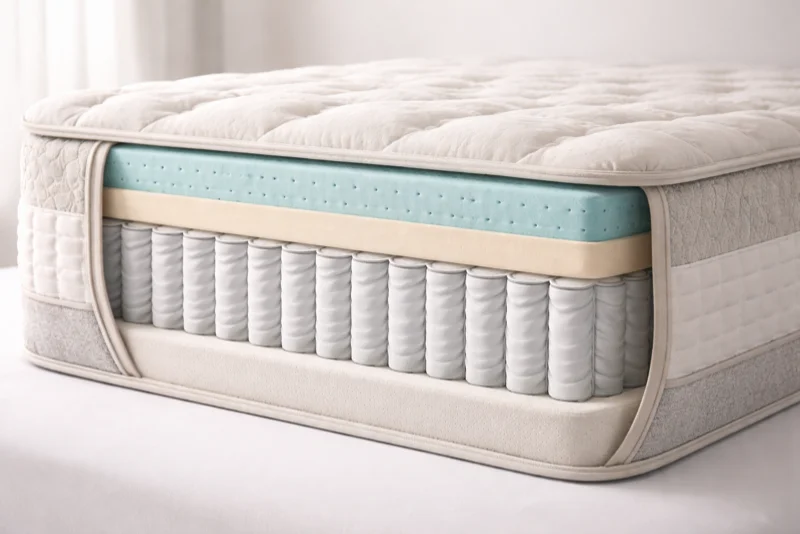
To achieve that ideal line, side sleepers generally benefit from a medium to medium-plush feel. Here is why:
Pressure Point Relief: Look for advanced memory foam or high-quality latex comfort layers. These materials cradle the more prominent parts of your body, such as your shoulders and hips, so the rest of your torso can remain properly supported.
Targeted Support: Hybrid mattresses with pocketed coils are an excellent option. These coils move independently, meaning the heavier pressure at your hips does not cause the mattress to dip under your lower back.
Cooling Technology: Because side sleepers tend to sink farther into the mattress than back sleepers, heat can become trapped more easily. Look for mattresses with phase-change material (PCM) or cooling gel infusions to help regulate your temperature.
The Missing Link: Your Pillow

Your mattress supports your spine from the shoulders down. Your pillow is responsible for supporting your cervical spine, or neck.
Side sleepers need a higher-loft, thicker pillow to fill the gap between the shoulder and the ear. If your pillow is too flat, your head tilts downward, straining your neck muscles throughout the night. A contoured memory foam pillow or a high-loft cooling pillow can provide the consistent height needed to keep your neck in a neutral position.
Quick Tips for Better Alignment Tonight
1. Use a Knee Pillow
Try placing a slim pillow between your knees. This helps prevent your top leg from pulling your pelvis forward, which reduces rotation in your lower spine.
2. Check Your Pillow Gap
If you can fit more than two fingers between your neck and the mattress while lying down, your pillow may not be providing enough support.
3. Rotate Your Mattress Regularly
Side sleepers place a lot of concentrated weight in two main areas. Rotating your mattress every 3 to 6 months helps the comfort layers wear more evenly and continue providing proper support.
Optimize Your Sleep

If you are waking up with shoulder pain or lower back stiffness, your current sleep setup may not be allowing for proper alignment. Upgrading to a sleep surface designed for pressure redistribution can make the difference between waking up sore and waking up restored.
FAQs
1. What is the best mattress feel for side sleepers?
Side sleepers usually benefit from a medium to medium-plush mattress because it can cushion the shoulders and hips while still helping the spine stay supported.
2. How can I tell if my spine is aligned while side sleeping?
A good side-sleeping position should create a straight line from your ears through your shoulders, hips, and knees. If your hips sink too far or your shoulders stay lifted, your mattress may not be supporting you properly.
3. Why do side sleepers need pressure relief?
Side sleepers place more pressure on the shoulders and hips. A mattress with contouring comfort layers can help reduce pressure in those areas and make it easier to stay comfortable through the night.
4. What type of pillow is best for side sleepers?
Side sleepers often need a higher-loft pillow that fills the space between the shoulder and the ear. This helps keep the neck in a neutral position instead of tilting down toward the mattress.
5. Can a knee pillow help side sleepers?
Yes. Placing a slim pillow between your knees can help reduce twisting in the lower back and keep your hips and pelvis in a more neutral position.
Explore Mattress Education
Related Articles
What Is Sleep Hygiene and Why Is It Important?
A good night’s sleep does not always begin when your head touches the pillow. It is often influenced by the choices you make throughout the day, the routine…
Read Article
What Kind of Pillow Is Best for Side, Back, and Stomach Sleepers?
The best pillow is not the same for everyone. Here is how side sleepers, back sleepers, and stomach sleepers can choose a pillow that fits the way they…
Read Article
Best Mattress Features for Couples Who Sleep Differently
If you and your partner do not sleep the same way, you are not alone. Here are the mattress features that can help couples sleep more comfortably together.…
Read ArticlePut what you’ve learned into practice.
Visit a Sleep Center showroom to compare mattresses and sleep products in person with pressure-free help from experienced specialists.
Find a Sleep Center